Five questions shaping the future of OEM: A conversation with Bjørn Kristian Sæstad
Bjørn Kristian Sæstad (also known as BK), NAVTOR’s OEM Director, delivers expert insights into the latest innovations and the barriers to innovation, that he believes are defining the evolution of maritime technology. From S-100 to USVs, to onshore ENCs, autonomous vessels, and BK’s love for leisure boating, discover how individual developments can converge to plot smarter routes towards tomorrow.
1. What do you see as the most noteworthy development in the industry over the course of the last year?
As I’m heavily involved in ECDIS related regulations and working closely with bridge manufacturers, the development of S-100 takes centre stage. From 1 January 2029, all new ECDIS units fitted on ships must comply with the S-100 Phase 1 performance standard. As we move closer to this deadline, we see a stronger commitment from regulatory bodies to finalise the necessary standards, while ECDIS manufacturers have started preparing for their next generation systems to support S-100, Phase 1.
NAVTOR, as an ECDIS chart kernel provider, is busy supporting our ECDIS OEM partners to ensure they achieve compliance in time.
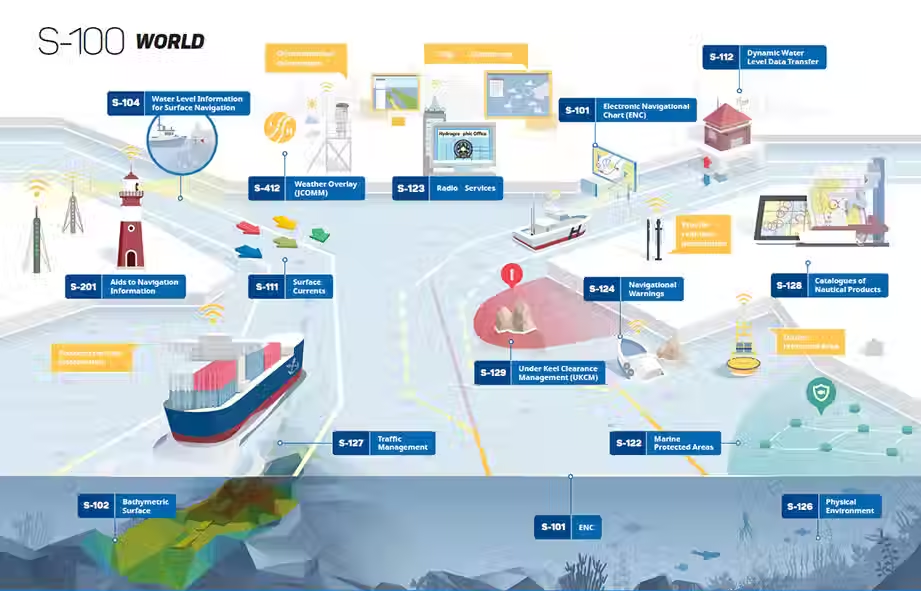
Key S-100 Phase 1 products include: S-101 (electronic navigational charts, ENC), S-102 (high-resolution bathymetric surface data), S-104 (dynamic tidal information, S-111 (real-time ocean current data), and S-124 (navigational warnings).
2. What key challenges face shipping companies and professionals in 2026 (and beyond)?
With the introduction of the S100 framework, more data will become available for both planning stations and ECDIS-based navigation. The request for richer data - often high resolution, dynamic, and real-time - creates some challenges for shipping companies and maritime professionals.
In the NAVTOR OEM department, we’re experiencing an increase in requests for navigation solutions that support advanced maritime operations.
The first and most relevant area is Uncrewed Surface Vessels (USVs) - autonomous or remotely operated maritime vessels that function without onboard crew. These offer safe, cost effective, and more persistent alternatives to manned research, intelligence or surveillance operations, operating anywhere from coastal waters to the open ocean. Further down the line comes Maritime Autonomous Surface Ships (MASS). These vessels will operate with varying degrees of automation, ranging from decision support to fully autonomous, unmanned ships. MASS promises enhanced safety with reduced operational costs and lower emissions. The IMO is developing a mandatory MASS Code, expected to be adopted by 2030, to regulate this rapidly evolving field.
With this kind of remote and autonomous operation, navigation and decision making are moved from ship to shore. This transition requires a new way of thinking, new technologies, and an updated regulatory framework. Right now, regulations are lagging behind innovation, and this gap is one of the key challenges facing the industry.
3. How can NAVTOR work to help its global customers meet these challenges?
When it comes to S-100, NAVTOR already has a smart and robust distribution infrastructure in place. This puts us in a strong position, as we can deliver S-100 data to vessels automatically and seamlessly, ensuring it reaches the bridge in time, and in the correct format. We are confident that we will retain our position as the leading eNavigation data provider as the industry transitions to S-100.

In the NAVTOR OEM department, we are working closely with our partners to customise navigational systems for remote operations. For example, shore-based systems require the same official maritime charts (ENCs) used on board vessels. Over the past few years, NAVTOR has worked successfully with hydrographic offices to adapt ENC licensing policies to support this new market. To further enable these operations, we have also launched a new web-based ENC service, ENC Online, providing flexible and secure access to official chart data for shore-based users.
4. Looking into your crystal ball, what issue/s do you believe will define maritime developments in the year to come?
Ever stricter regulations on emissions, including the IMO’s global Net-Zero Framework, will continue to be a major driver for optimised solutions on board.
The continuous demand for remote operations will become a game changer and catalyst for innovation. We are already seeing rapid growth in USV solutions, and I believe the uptake of MASS will grow slowly but steadily, with decision support acting as a primary driving force. And off course, AI will play an important role here.
Sub-ECDIS, also referred to as ECS (Electronic Chart Systems), represents non-mandatory electronic navigation systems used by vessels not required to carry full IMO-compliant ECDIS, such as smaller commercial ships, workboats, and yachts. These systems fill a regulatory gap by providing digital navigation capability without the rigorous, high-cost, and hardware-intensive certification required for SOLAS-compliant ECDIS. These vessels are increasingly using unofficial data and noncompliant digital hardware for navigation. The International Hydrographic Organization (IHO) focuses on defining standards for this sector, particularly as paper chart production is reduced. Defining regulations for this market is challenging, but also very interesting, and NAVTOR is contributing to this work on behalf of the industry. We look forward to providing smart and safe solutions to this new market for years to come, based on official maritime charts (ENCs).
5. What’s one maritime innovation you wish existed but doesn’t (yet)?
My passion is technology and private boating. The leisure market is not as regulated as the professional maritime market, which opens space for innovation. It’s very competitive by nature and this creates a driver for smarter solutions that exploit new technology to meet customer needs. In that market, you can adapt quickly.
In my own boating life, I can plan a route at home, or on my laptop, adjusting it on my smartphone, and then step onto my boat to find the route is already updated in my chart-plotter.
Crowdsourcing gives me access to detailed high-resolution charts, and community sharing provides valuable information while underway. The chart information is customised to my needs at any scale. Everything is achieved in a smart, safe, and harmonised way, and the navigation software keeps improving.
In general, I wish this kind of innovation was happening quicker in the professional maritime sector. I understand the need for strict regulations, but when regulations fail to keep pace with modern shipping needs, progress slows. In addition, type approval and certifications are very costly, making it a challenge for manufacturers and service providers to justify the costs involved to release new and improved products and services.
In terms of one innovation that’s on the horizon that I wish were already here, it’s S-100. For the last 15-20 years, we’ve talked about S-100 being the next major revolution, yet we still need to wait at least another three years. All this is due to slow progress on regulations. By now we should already be discussing the next big step for S-100.
That said, NAVTOR is not standing still. We contribute to maritime working groups to help move regulations forward, for the benefit of the entire shipping industry.
Together with our partners, we make harmonised and integrated solutions. In the OEM department, we work closely with the major ECDIS manufacturers to make sure the crew onboard can operate as efficiently as possible. From automatic chart updates to NavBox, to planning routes in NavStation, to navigating these routes in ECDIS, all in a smart and seamless workflow.